Wednesday, 18 September 2013

Can a pirate be good for business?


Today is international Talk like a Pirate day.  Not exactly the type of event that makes the world stop, but a good enough reason for creative marketers to have a little fun while promoting business.

Both Krisy Kreme and Long John Silver's took to Twitter to create a buzz about their pirate offerings (#TLAPD).

Krispy Kreme in Portland, Beaverton and Vancouver gave a FREE doughnut to customers who talk like a pirate.  In some cases customers who dressed like pirates were rewarded with a dozen FREE doughnuts.

Long John Silver's simply required a half decent "ARRR" from customers to receive a FREE piece of fish.

Now if only the Rum manufacturers would see the brilliance of this marketing opportunity ;-)

Monday, 16 September 2013

Brilliant use of technology


There is a growing unease in society with the lack of manners people display when using mobile devices.  We've all been in the vicinity of people talking loudly on their phones in public spaces or sneaking a peek  a their texts during a conversation.  Seinfold joked about this very thing when he referred to people putting their mobiles on the table when meeting somebody.  According to him it sends the signal that the person has other options, if you bore him he can start texting any time.

What do you do in such a situation?  I ask the person politely to stop texting as I value my time and their undivided attention.  Should it happen a second time, I simply walk away.

Well, that was my tactic until I discovered Polar Beer's solution!


This company has listened to the grievances of its public.  Mobile devices are draining the life out of social encounters. The solution to this problem?  A stubby holder that not only keeps your beer cold, but blocks all 3G and 4G signals within a 1.5m range.  Sheer brilliance and something polar beer consumers can drink to - cheers!

Friday, 6 September 2013

The end is in sight!

Today is election day in Australia, finally!  This has been a long and exhausting run - and not only for the politicians.  The Courier Mail provides one final look at the weirdest moments of this election campaign.

With my new found insight into social media and marketing, this campaign took on a whole new dimension for me.  It was interesting to note that Labor spent most of their efforts on social media, while foregoing traditional ways of advertising.  The wisdom and reason behind this eludes me.  Surely all marketers know that social media is just another way of reaching target markets and not THE way.

In that sense the Coalition has run an excellent race.  Our oldest will vote for the first time today and our household was overrun with advertising media from the Coalition.  It arrived in the form of personalized letters and the variety impressed me.  Some explained their policies, some was written as thank you notes for the patience of young voters to put up with it all and others were promises that they asked young voters to hang onto.  The idea is accountability - the Coalition asked young voters to check whether they keep their word.  Maybe a bit risky when it comes to young impressionable voters and the track record of politics and specifically election promises ... but much better than the deafening silence from the other parties.

The only candidate that came knocking was the Coalition one.  We have also received  some advertising material from Clive Palmer.  However, that is all behind us now and all that remains is to learn in order to improve on future campaigns.


Friday, 30 August 2013

Reflections

A lot of university courses currently require students to write reflective essays.  The aim is to stimulate internal debate and to come to terms not only with the subject matter, but also with your degree of understanding.

Personally I am not a fan of reflective essays.  However, my problem does not lie with the idea or the process, but merely with the format.  So it is therefore not unusual that I find myself in a reflective mood ... usually on a Friday afternoon in an attempt to assimilate a week's worth of knowledge.

On this particular Friday afternoon I find myself reflecting on the future of journalism itself.  This whole process was sparked by tweets from PBS Media Shift.  They are running a series on this topic entitled Back to J-school.
Click on the image for the full series. Original photo by Taqi®™ on Flickr and used here with Creative Commons license.

Although there are no clear cut answers, it highlights the dilemma the industry and especially universities find themselves in.  What should journalism students be learning?  How do you prepare students in a time of great uncertainty about the future of journalism?

Garry Kebel asks whether universities that are "designed to make slow, incremental, deliberative and consensual changes [can] respond with the speed, risk-taking and adaptability demanded by today’s technological disruptions?"  I agree with his recommendation of teaching (all) students the necessity of change and risk-taking.  Although universities will struggle with this approach initially, we need to understand that it is OK to take risks and fail - the real challenge lies in the ability to adapt and try again.

As an ex-teacher I initially rebelled against Kebel's  idea of hiring people to teach whatever is in demand.  He argues that it is then up to the teacher to stay current with other skills or loose his/her job.  It just goes to show how entrenched we are in our way of thinking.  After reflection I cannot produce one valid reason why this should not work.  We are living in an ever changing world, why on earth not demand our teachers keep up with it?


Sunday, 18 August 2013

Political campaigns

While the rest of the country is reaching saturation point with the election campaign, I am having the time of my life.  My interest is not the politics per se, but the public relations campaigns keep me spellbound.

It is simply not enough for modern politicians to speak in town halls, shake hands and kiss babies.  They are scrambling to stay in touch with voters on all the social media platforms.  What I love about the new media is that you simply cannot fool people - they detect insincerity quick smart.

My advice would be to choose only a few platforms that you really understand.  Kevin Rudd is crediting social media for gaining the youth vote and securing his '07 victory.  So it comes as no surprise that he is once again turning to social media.  He is an avid user of Twitter.

However, what he really is gaining fame for this time round is his beloved selfies.  The public seems split on this:  on the one hand there are people lining up for a selfie with Mr Rudd, on the other hand there are young people feeling quite offended by the selfies he tweets.  There is a real danger in patronizing the younger generation when you try to emulate them.  They want the Prime Minister to engage in conversation with them, to actually listen and value their input.

Yet, with Kevin Rudd I feel that what you see is what you get.  The public often complained about Julia Gillard displaying two personalities.  People found her charming and engaging when meeting her face to face; traits she did not display when addressing the nation.  A big part of Julia's downfall lies with her PR team.  It is the responsibility of a PR team to gauge public opinion and advice the politician on changes to improve relations.

Advice Mr Abbott's PR team should be dishing out in spades right about now.  It is one thing to be honest, but quite another to show lack of class.  Mike Carlton writes a very satirical article on Mr Abbott.  Just to put this in context, Carlton explains it as follows:

 Satire doesn't create anything new ; it just amplifies and enlarges what's already there.

It also seems that the race is the only thing our politicians are focusing on  at the moment.  When one announces a rather strict and backwards policy on asylum seekers, the other one pulls out a draconian policy to "outshine" it.  If one has 1 377 901 followers on Twitter, well then the other one should create the impression of people liking his policies too...

Thus, while the nation feels indecisive about choosing a leader, I too am still indecisive ... will social media once again play a vital role, will the PR teams truly engage in the development of meaningful relationships or will they simply be spin doctors focusing on catch phrases like "positive politics", "marriage equality" and "stopping the boats"?



Wednesday, 7 August 2013

Where do you hang out?

I must be the last person to finally "get" Twitter!  Until recently I have banished Twitter to the sphere of teenagers who would tweet every single thought that enter their head .... in a 140 words .... without editing it .... nightmarish stuff.  How wrong can one person be?

I was forced to spend time on Twitter for a course I am enrolled in.  My instructions was to follow a few journalists and to study their tweets and interactions.  For me Twitter is like an old transistor radio with bad reception:  it takes time to fine tune it into the station that you want to listen to.  However, once you have eliminated all the white noise, it is pure gold.

I am discovering news stories as they happen and read about stories that don't even make it into the papers.  It is a wonderful platform to mingle with the great minds of your chosen field.  And those 140 words that seemed so utterly ridiculous turns out to be a wonderful way of  illustrating that you grasped the essence of a story.

It is save to say that I love Twitter.  How many social platforms do you use and which ones are your favourites?

Monday, 5 August 2013

No evidence of journalistic principles


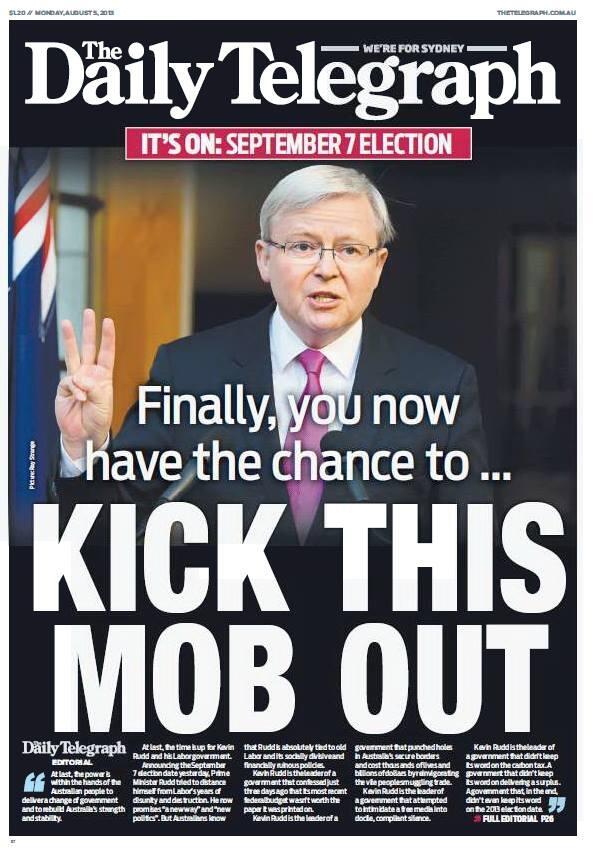
The Australian federal election has been called for the 7th of September 2013.  I think it is fair to say that most people have expected the newspapers to dig up dirt on the candidates to use as sensationalized headlines.

However, The Daily Telegraph sunk to a new low with this front page:
Of course no article can be 100% subjective, but at least most journalists aim to represent multiple sides to an argument.  That is journalists not working for News Corp.  Paul Sheehan wrote an insightful article explaining the reasoning behind this front page.  As we all know News Corp is owned by Rupert Murdoch - a man fighting to keep his news empire turning over a handsome profit.  And this is precisely here where the problem lies ...

Newspaper circulation has been in decline worldwide for quite some time.  In addition to that, Murdoch also faces a threat to his Foxtel cable TV monopoly in Australia.  This threat is in the form of Labor's National Broadband Network.

In Mr Murdoch's own words this is about business.  My opinion is that you are going about it in the wrong way Mr Murdoch - you are mixing mediums that should operate independently and in doing so you might bring about your downfall.

You have proven that you are quite willing to use unethical and even unlawful tactics to gain a scoop.  Does it then come as a shock that people are angered by your (once again) misuse of power in a blatant attempt to influence the Australian public?  What angers people even more is that you are doing it purely for your own self interest.  The rich dictating to the masses in order to enrich themselves further.

People are no longer solely depended on newspapers to be informed, there are countless (free) sources online that provide a multitude of views and insights into all kinds of issues.  Also, even without the NBN people are streaming their entertainment through the internet.  To me this looks like the desperate actions of a desperate man - a man who has not figured out how to change with the times and therefore finds his empire dwindling.